10 Incident Management Best Practices to Master in 2026
Discover 10 actionable incident management best practices. Improve detection, response, and resilience for your engineering and support teams. Read now!
In today's complex digital ecosystems, incidents are an inevitable part of operations. A minor glitch can cascade into a major outage, directly impacting customer trust, brand reputation, and revenue. The critical difference between a minor hiccup and a catastrophic failure often lies in one thing: a mature, well-practiced incident management process.
Gone are the days of ad-hoc firefighting and stressful, finger-pointing war rooms. Modern engineering, QA, product, and support teams require a structured, data-driven approach to not only resolve issues faster but also to learn from them and prevent recurrence. Effective incident management is no longer just about fixing what’s broken; it's about building a culture of reliability and continuous improvement. It’s the framework that provides clarity during high-stress events and turns moments of failure into opportunities for growth.
This article cuts through the noise to deliver a prioritized, actionable collection of 10 essential incident management best practices. We will explore practical strategies designed to transform your response from reactive chaos to proactive control. You will learn how to implement structured systems for:
- Rapid detection and alert orchestration
- Clear incident communication and status updates
- Blameless post-incident reviews and root cause analysis
- Structured on-call rotations and incident command
- Runbook development and playbook automation
- Strategic use of SLOs and error budgets
- Comprehensive observability and proactive testing
Each practice is designed to provide your teams with the frameworks needed to build a more resilient, reliable, and predictable system. By implementing these strategies, you can minimize downtime, protect your user experience, and foster a culture of operational excellence. Let's get started.
1. Incident Classification and Severity Levels
A robust incident management process begins with a clear, shared understanding of what constitutes an incident and how severe it is. Establishing a formal framework for incident classification and severity levels is a cornerstone of effective incident management best practices. This system removes ambiguity, ensures consistent prioritization, and guarantees that the right resources are mobilized for the right problems without delay.
The goal is to categorize incidents based on their impact on users, business operations, and system health. Most organizations use a scale from P1 (most critical) to P4 (least critical), though the specific naming can vary. A well-defined matrix considers factors like system availability, data integrity, security implications, and the percentage of affected users.
Why This Is a Critical First Step
Without a standardized classification system, teams are left to make subjective judgments under pressure. A minor bug might be treated with the same urgency as a site-wide outage, leading to resource misallocation and burnout. Conversely, a critical issue might be underestimated, prolonging its impact on customers. A clear framework ensures every incident receives a proportional and predictable response.
Key Insight: A well-defined severity matrix acts as a contract between engineering, product, and support. It aligns expectations and provides a common language for discussing impact and urgency during high-stress situations.
How to Implement It Effectively
Successful implementation requires collaboration and clear documentation.
- Define Clear Criteria: Involve all relevant teams (engineering, support, product) to create a severity matrix. For example, Stripe's model clearly defines P1 as a complete service outage, while P3 covers non-critical feature malfunctions.
- Create Decision Aids: Develop flowcharts or decision trees to help responders quickly and accurately classify an incoming issue. This is especially useful for on-call engineers who need to make fast decisions.
- Automate and Refine: Use monitoring tools to automatically assign a preliminary severity level based on error rates, latency spikes, or specific log patterns. Tools like Monito can further enhance this by using AI to analyze the scope of impacted user sessions, providing crucial context that helps differentiate a P2 from a P3 incident.
- Review and Iterate: Use historical incident data to review your thresholds quarterly. Are too many incidents being classified as P1? Are P3 incidents frequently being escalated? Adjust your criteria based on real-world patterns.
2. Rapid Detection and Alert Orchestration
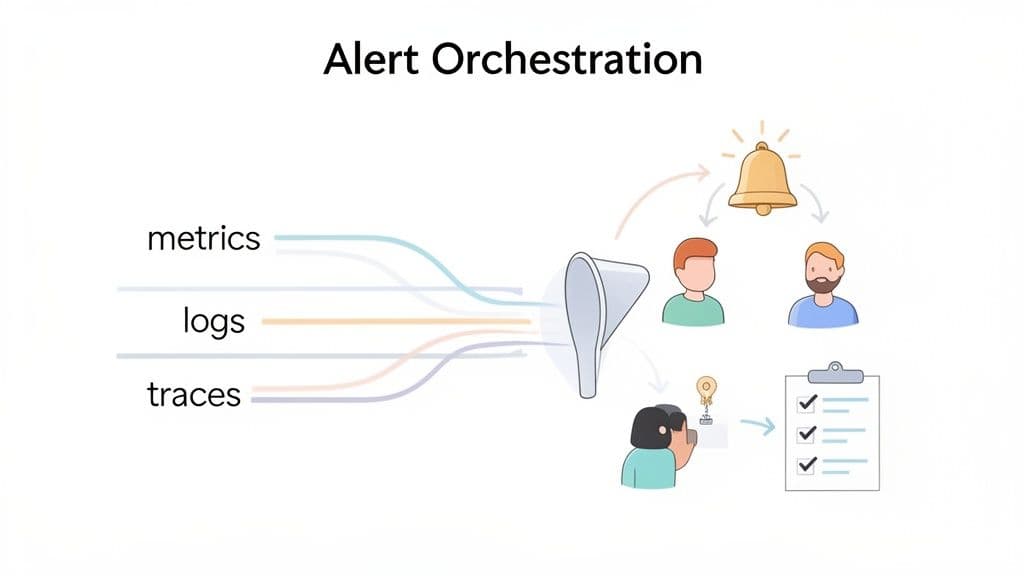
Once an incident occurs, the clock starts ticking. A cornerstone of modern incident management best practices is minimizing the time it takes to discover a problem. This is achieved through rapid detection and alert orchestration: a proactive system that combines comprehensive monitoring with intelligent alert routing to ensure the right people are notified of real issues, instantly.
This practice moves beyond simple threshold-based alarms. It involves correlating signals from various sources like metrics, logs, and traces to identify anomalies early. Advanced alert orchestration platforms then deduplicate redundant notifications and route a single, actionable alert to the appropriate on-call responder, effectively combating alert fatigue and speeding up response times.
Why This Is a Critical First Step
A slow or noisy detection system directly translates to longer outages and greater customer impact. Without intelligent orchestration, on-call engineers are flooded with low-signal alerts, leading them to ignore or mistrust the system. This "crying wolf" scenario is dangerous, as a critical alert can easily get lost in the noise, delaying the start of the incident response process.
Effective alert orchestration ensures that when a pager goes off at 3 AM, it's for a legitimate, high-impact issue. It transforms a chaotic stream of notifications into a focused, prioritized queue of problems that need immediate attention, making the entire incident management process more efficient from the very first minute.
Key Insight: The goal of alerting isn't to notify you of every anomaly; it's to provide actionable, contextualized signals that empower a fast and accurate response. High signal-to-noise ratio is the ultimate KPI for a healthy monitoring system.
How to Implement It Effectively
Building a robust detection and alerting pipeline requires a strategic, layered approach.
- Start with High-Signal Alerts: Begin by instrumenting critical user journeys and core infrastructure components. Focus on alerts that directly correlate with user-facing impact or system failure, like a spike in 5xx server errors or a sudden drop in successful checkouts.
- Correlate and Deduplicate: Use tools like Datadog's correlation engine or Opsgenie's aggregation rules to group related alerts. For instance, a single database issue might trigger dozens of downstream alerts; these should be collapsed into one parent incident.
- Enrich Alerts with Context: An alert is far more useful when it comes with context. Integrate your alerting with tools like Monito to automatically attach relevant session recordings. When an engineer gets an alert for a front-end error, they can immediately see the user's actions leading up to it, drastically reducing reproduction and investigation time.
- Review and Tune Weekly: Treat your alerting system like a product. Dedicate time each week to review false positives, noisy alerts, and incidents that were missed. Continuously tune thresholds and logic to improve accuracy and maintain the trust of your on-call teams.
3. Post-Incident Review (PIR) and Blameless Root Cause Analysis
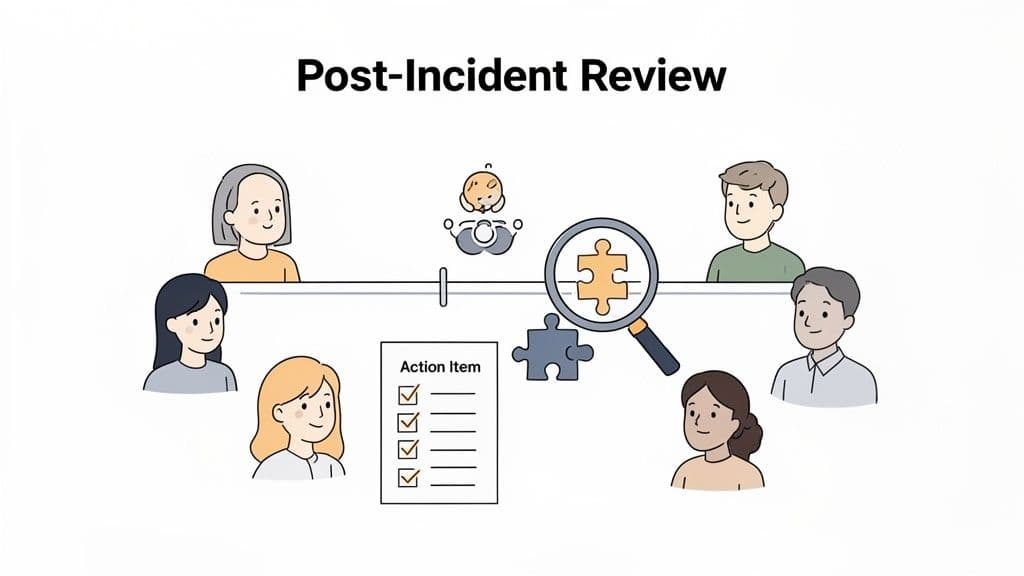
Resolving an incident is only half the battle; the real value comes from learning how to prevent it from happening again. This is where a formal Post-Incident Review (PIR), often called a postmortem, becomes an indispensable part of your incident management best practices. This structured, non-punitive process focuses on uncovering systemic issues rather than assigning individual blame, turning costly failures into invaluable opportunities for improvement.
The goal is to analyze the entire incident lifecycle, from detection to resolution, to identify contributing factors and define concrete action items. A blameless approach, pioneered by companies like Etsy and Google, is crucial. It creates psychological safety, encouraging engineers to share information openly without fear of reprisal, which is the only way to uncover the true, often complex, root causes.
Why This Is a Critical Follow-Up Step
Without a blameless PIR, teams are doomed to repeat their mistakes. Incidents become recurring annoyances rather than catalysts for strengthening system resilience. This process builds institutional knowledge, improves runbooks, and refines monitoring, ultimately reducing the frequency and severity of future incidents. It’s the engine of continuous improvement in any mature engineering organization.
Key Insight: A blameless postmortem assumes that people do not cause failures, but systems and processes do. It shifts the question from "Who made a mistake?" to "What factors in our system allowed this mistake to have an impact?"
How to Implement It Effectively
A successful PIR process is structured, timely, and actionable.
- Schedule Promptly: Conduct the PIR within 48-72 hours of incident resolution. This ensures memories are fresh and details are accurately captured. Include all key responders, engineers, and relevant stakeholders.
- Establish a Clear Template: Use a standardized document that covers a timeline of events, contributing factors, impact analysis, and specific, assigned action items. Slack and Netflix have well-documented internal processes that serve as great models.
- Facilitate Constructively: Appoint a neutral facilitator to guide the discussion, keeping it focused on systems and processes. Their job is to ensure the conversation remains blameless and productive.
- Incorporate Objective Evidence: Use monitoring dashboards, logs, and user session data to reconstruct the timeline. Tools like Monito can add immense value here, providing session recordings that show the exact user-facing impact, which helps eliminate guesswork and provides objective data for the review.
- Track Action Items: PIRs are useless without follow-through. Assign each action item an owner and a deadline in your project management tool. These items often feed directly into the software bug life cycle as new tickets to be prioritized.
4. Clear Incident Communication and Status Updates
During a service disruption, silence is one of the most damaging things for customer trust and internal alignment. A systematic approach to clear incident communication and status updates is a non-negotiable component of modern incident management best practices. This practice ensures all stakeholders, from customers to internal teams, receive timely, accurate, and relevant information throughout an incident’s lifecycle.
The goal is to move from chaotic, ad-hoc announcements to a predictable, templated communication strategy. This involves using dedicated channels like status pages, designated Slack channels, and automated notifications to disseminate information. It’s about managing expectations, reducing the flood of "what's happening?" inquiries, and allowing the technical team to focus on resolution.
Why This Is a Critical First Step
Without a proactive communication plan, speculation and misinformation thrive. Customers become frustrated, support teams are overwhelmed, and internal departments operate without crucial context. A well-executed communication strategy turns a potentially chaotic situation into a managed process, demonstrating transparency and control. It builds trust by showing customers you are aware of the issue and actively working on a fix.
Key Insight: Incident communication is a separate, parallel workstream to the technical response. Assigning a dedicated Communications Lead ensures that messaging remains clear, consistent, and frequent, freeing the Incident Commander to focus solely on resolving the issue.
How to Implement It Effectively
Successful communication hinges on cadence, clarity, and the right tooling.
- Establish a Communication Cadence: Define an update schedule based on severity. For example, a P1 incident might require updates every 15 minutes, while a P3 could be updated hourly. This sets clear expectations for everyone involved.
- Use Templates and Plain Language: Create pre-approved templates for different incident types and severities. Avoid technical jargon; instead, explain the impact in business and user terms. For example, GitHub’s status page excels at this, clearly stating which services are affected and the user impact.
- Leverage Dedicated Channels: Centralize all incident communication. Use a public status page for external updates and a dedicated "war room" channel in your messaging platform for internal coordination. For streamlined communication during an incident, implementing systems that can automatically be forwarding emails to Slack ensures all stakeholders receive timely updates in their preferred communication channel.
- Share Concrete Evidence: Enhance updates by sharing specific data. With a tool like Monito, you can share screen recordings of an issue directly in the war room to unify the team's understanding. You can also reference specific user session impacts, stating "We've confirmed 15% of checkout sessions are affected," adding valuable, data-backed context to your updates.
5. Structured On-Call and Incident Command System
When a critical incident strikes, chaos can quickly derail the response effort. Adopting a structured on-call rotation and an Incident Command System (ICS) is one of the most powerful incident management best practices for replacing chaos with clarity. This framework, adapted from emergency services, establishes defined roles and clear lines of authority, ensuring a coordinated and efficient response.
The system assigns specific responsibilities, such as an Incident Commander (IC) for overall coordination, a Technical Lead for deep-dive investigation, and a Communications Lead for stakeholder updates. This structure prevents redundant work, clarifies decision-making, and allows subject matter experts to focus on solving the problem instead of managing logistics. A well-managed on-call rotation supports this by ensuring responders are prepared, rested, and not perpetually burned out.
Why This Is a Critical First Step
Without a formal command structure, incident response often becomes a free-for-all. Too many people jump on a call, offering conflicting opinions, while critical tasks like customer communication are forgotten. The ICS model provides immediate order, designates a single source of truth, and creates a predictable rhythm for even the most severe incidents. It transforms a high-stress, reactive scramble into a focused, methodical process.
Key Insight: The Incident Commander's role is not to fix the problem themselves, but to orchestrate the response. This person directs resources, removes roadblocks, and ensures all facets of the incident, from technical resolution to communication, are being handled effectively.
How to Implement It Effectively
Bringing structure to your response requires defining roles and establishing clear processes.
- Define Key Roles: Start with a few core roles: Incident Commander (overall strategy), Technical Lead (technical investigation), and Communications Lead (internal/external updates). Document the responsibilities for each. As you mature, you can add roles like a Scribe to document the timeline.
- Establish Clear Escalation Paths: Use tools like PagerDuty to create automated escalation policies. If the primary on-call engineer doesn't acknowledge an alert within five minutes, it should automatically escalate to the secondary on-call, and then to the team lead.
- Provide IC Training: The Incident Commander role requires leadership, not just technical skill. Run quarterly drills or simulations to give potential ICs practice in a low-stakes environment.
- Optimize On-Call Rotations: Implement one or two-week rotations with clear handoffs to balance the burden and allow for adequate recovery time. Track metrics like pages per shift and responder satisfaction to identify signs of burnout.
- Leverage Tooling for Command: The IC needs a high-level view fast. Pre-configure dashboards in tools like Monito to provide a quick summary of user impact, session errors, and performance metrics, allowing the IC to assess the situation without digging into raw logs. This context helps them direct technical resources more effectively.
6. Runbook Development and Playbook Automation
Relying on individual heroics during a crisis is a recipe for inconsistency and burnout. A core component of modern incident management best practices is the creation of runbooks and automated playbooks. These are pre-written, step-by-step guides that document the procedures for diagnosing and resolving common incident scenarios, enabling a faster, more predictable response.
Runbooks serve as a single source of truth, combining manual diagnostic steps, communication templates, and automated remediation scripts. They reduce cognitive load on responders, allowing them to focus on execution rather than discovery. When a known issue arises, teams can immediately turn to a tested runbook, dramatically reducing mean time to resolution (MTTR).
Why This Is a Critical First Step
Without runbooks, every incident response is an improvisation. Responders waste precious time rediscovering tribal knowledge, testing different hypotheses, and potentially making mistakes under pressure. This leads to longer outages and inconsistent outcomes. A well-maintained runbook library ensures that every response follows a proven, optimized path, regardless of who is on call.
Key Insight: Runbooks transform incident response from an art into a science. They codify institutional knowledge, turning reactive problem-solving into a repeatable, scalable process that empowers even junior engineers to respond effectively.
How to Implement It Effectively
Start small and build momentum by documenting your most frequent and impactful incidents first.
- Prioritize and Document: Identify your top 5-10 most common incidents from historical data. Create a detailed runbook for each, outlining trigger conditions, diagnostic steps, remediation actions, verification procedures, and rollback plans. A cornerstone of efficient incident response is the clear definition of a standard operating procedure, ensuring consistent actions during critical moments.
- Version Control Your Runbooks: Store runbooks in a version control system like Git, alongside your application code. This treats your operational knowledge as a critical asset, allowing for peer reviews, change tracking, and continuous improvement.
- Automate Safe, Idempotent Actions: Identify repetitive, low-risk tasks within your runbooks and automate them. Actions like restarting a service, scaling resources, or reverting a safe deployment are prime candidates for automation using tools like AWS Systems Manager.
- Integrate Diagnostic Tooling: Enhance runbooks by embedding direct links and commands for your tools. For instance, with Monito, you can add a step like: "Reproduce the bug using the attached user session recording" to provide immediate context, helping engineers validate fixes without guesswork.
7. Error Budget and Risk-Based Release Planning
A mature incident management process moves beyond reactive firefighting to proactively balance innovation and reliability. Establishing an error budget provides a quantitative framework for this, transforming reliability from an abstract goal into a measurable resource that guides development and release decisions. It's a powerful tool in your toolkit of incident management best practices.
The concept is simple: if your Service Level Objective (SLO) for availability is 99.9%, your error budget is the remaining 0.1%. This is the acceptable amount of unavailability or error your service can experience over a set period (e.g., 43 minutes per month) without breaching your promise to users. This data-driven approach aligns engineering and product teams around a shared understanding of risk.
Why This Is a Critical Next Step
Without an error budget, debates between shipping new features and improving stability are often based on opinion and gut feeling. This can lead to tension, with product teams pushing for velocity and engineering teams advocating for caution. An error budget replaces subjective arguments with objective data, creating a clear rule: if the budget is spent, all new feature releases are frozen, and the team's priority shifts to reliability work until the budget is replenished.
Key Insight: An error budget is a contract that empowers teams to take calculated risks. It reframes "failure" as a planned-for cost of innovation, giving engineers the autonomy to move fast when the service is healthy and a clear mandate to slow down when it's not.
How to Implement It Effectively
Effective implementation hinges on accurate measurement and cultural buy-in.
- Define Meaningful SLOs: Your error budget is derived from your SLOs, so they must reflect the user experience. Instead of just server uptime, track customer-centric metrics like successful login rates or API request success percentages.
- Automate Budget Tracking: Manually calculating error budget consumption is not scalable. Use monitoring and observability tools to automatically track your SLOs and calculate the remaining budget in real time. Set up alerts for high "burn rates" (consuming the budget too quickly) to trigger early investigation.
- Quantify Incident Impact: To properly deduct from the budget, you need to measure an incident's true impact. Tools like Monito can analyze user session data to quantify the precise number of users affected by an error or outage, allowing you to connect technical failures to business outcomes (e.g., "this P2 incident impacted 5% of user sessions, consuming 15% of our weekly error budget").
- Integrate into Release Gates: The error budget should be a core component of your CI/CD pipeline. Create automated checks that prevent a deployment from proceeding if the remaining error budget is below a predefined safety threshold.
8. Comprehensive Observability and Instrumentation
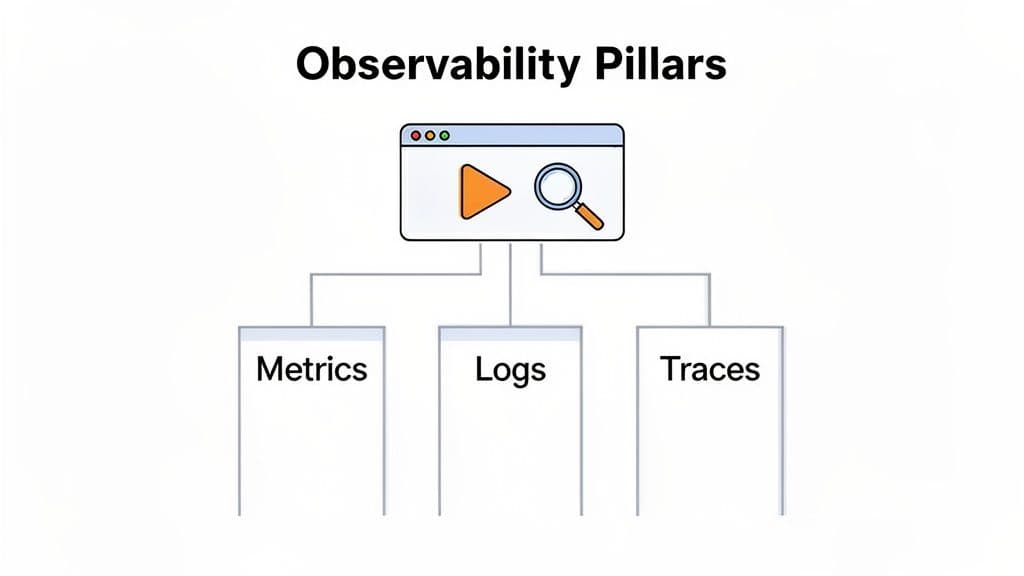
To effectively manage incidents, you must first be able to see and understand what is happening inside your systems. Comprehensive observability and instrumentation is the practice of gaining deep, multi-layered visibility into system behavior. This goes beyond simple monitoring; it involves collecting metrics, logs, and traces (the "three pillars") to enable the rapid diagnosis of both known and unexpected failure modes.
Effective instrumentation ensures that when an incident occurs, teams are not flying blind. It provides the necessary data to ask novel questions about system performance and user impact. This holistic view combines application performance data, infrastructure health metrics, and user-centric analytics to reveal the full story behind an incident, which is fundamental to modern incident management best practices.
Why This Is a Critical First Step
Without deep observability, incident response becomes a guessing game. Teams are forced to rely on tribal knowledge and manual correlations to find the root cause, significantly increasing mean time to resolution (MTTR). A well-instrumented system provides a clear, data-driven path from symptom to cause, empowering engineers to solve problems faster and more confidently.
Key Insight: Observability is not just about collecting data; it's about connecting it. The ability to correlate a backend trace with a specific user's session or a business KPI is what transforms raw data into actionable intelligence during an incident.
How to Implement It Effectively
Building a comprehensive observability strategy requires a proactive, multi-faceted approach.
- Instrument All Critical Journeys: Don't just monitor infrastructure. Instrument the entire user journey, from frontend interactions to backend API calls. Track business metrics like sign-ups or purchases alongside technical metrics to quantify impact.
- Implement Distributed Tracing: In a microservices architecture, use correlation IDs to trace a single user request as it travels across different services. Tools like Datadog, New Relic, and open standards like OpenTelemetry make this feasible.
- Combine Backend and Frontend Views: A backend trace might show a 200 OK status, but the user could still be experiencing a critical UI bug. Enhance backend observability with frontend session replay tools like Monito. This allows you to see the exact user experience tied to a backend issue, bridging the gap between infrastructure metrics and real-world impact.
- Monitor Frontend Performance: Actively track frontend issues such as JavaScript errors, slow resource loading, and API latency as experienced by the user's browser. Learn more about effective strategies for handling JavaScript errors to complete your observability picture.
9. Incident Metrics and Continuous Improvement
You cannot improve what you do not measure. A data-driven approach using incident metrics and continuous improvement transforms incident management from a reactive firefighting exercise into a proactive strategy for enhancing system resilience. This practice involves tracking key performance indicators (KPIs) to identify systemic weaknesses, justify investments, and drive meaningful, long-term improvements.
The core idea is to move beyond simply closing tickets. By analyzing metrics like Mean Time To Detect (MTTD), Mean Time To Resolve (MTTR), and Mean Time Between Failures (MTBF), teams gain objective insights into their process effectiveness. This quantitative feedback loop is essential for refining one of the most critical aspects of incident management best practices: getting better over time.
Why This Is a Critical First Step
Without metrics, "improvement" is based on gut feelings and anecdotes. Teams may invest time and resources in areas that yield minimal impact, while critical bottlenecks go unnoticed. Tracking trends helps pinpoint where the process is failing, whether it's slow detection, inefficient diagnosis, or inadequate post-incident follow-up. It provides the hard evidence needed to prioritize tooling, training, or architectural changes.
Key Insight: Incident metrics are not for assigning blame. They are diagnostic tools for the health of your system and processes. When shared transparently, they foster a culture of collective ownership and continuous learning.
How to Implement It Effectively
A successful metrics program requires consistency and a focus on actionable data.
- Define Baseline Metrics: Before launching new initiatives, establish a baseline for key metrics like MTTR and incident frequency. This allows you to accurately measure the impact of changes, such as adopting new runbooks or tools. PagerDuty's analytics dashboard provides an excellent starting point for this.
- Track Actionable KPIs: Focus on metrics that directly reflect performance. MTTR is a classic, but also consider tracking the reduction in "unclear bug reports" as a success metric after implementing better diagnostic tools.
- Correlate Metrics to Changes: When you introduce a new tool or process, explicitly track its effect on your chosen KPIs. For example, Monito's session replay capabilities directly reduce the "time to reproduce," a crucial component of MTTR. By tracking this specific sub-metric, you can prove the tool's value and see its impact on the overall resolution time.
- Review and Iterate: Schedule quarterly reviews to discuss trends. Is MTTR creeping up? Is a specific service causing a disproportionate number of incidents? Use these insights, as outlined in Google's SRE framework, to set clear improvement goals for the next quarter.
10. Chaos Engineering and Resilience Testing
Effective incident management isn't just about reacting faster; it's about building systems that are inherently resilient to failure. Chaos engineering and resilience testing is a proactive practice that shifts teams from a reactive to a preemptive posture. It involves deliberately injecting controlled faults into a system to uncover weaknesses before they manifest as production incidents.
The core principle is to treat failures as inevitable and test the system’s ability to withstand them. By simulating events like network latency, service crashes, or resource exhaustion in a controlled environment, teams can identify hidden dependencies and brittle components. This practice, pioneered by companies like Netflix with its Chaos Monkey, builds confidence that your services can gracefully handle unexpected turmoil.
Why This Is a Critical First Step
Without proactive resilience testing, your first encounter with a specific failure mode will likely be during a real, customer-impacting outage. Chaos engineering moves this discovery process into a safe, observable setting. It answers the question, "What happens if this component fails?" before your customers are forced to. This is a fundamental part of mature incident management best practices, as it reduces the frequency and severity of incidents over time.
Key Insight: Chaos engineering turns the unknown unknowns of system failure into known, manageable risks. It builds not just more resilient software, but also more experienced and prepared engineering teams.
How to Implement It Effectively
Getting started with chaos engineering requires a careful, incremental approach.
- Start Small and Contained: Begin with low-risk experiments in a staging environment. Target a single, non-critical service and hypothesize what will happen if it fails. For example, "If our recommendation service goes down, the homepage will still load but without the recommendations widget."
- Run Experiments During Business Hours: Contrary to intuition, the best time to run chaos experiments is when the full team is online and available to observe and respond. This minimizes the mean time to recovery (MTTR) if something unexpected occurs.
- Quantify User Impact: Use monitoring tools to measure the blast radius of your experiments. For instance, Monito can capture user-visible impact by showing precisely how many user sessions were affected when you terminated a pod or introduced latency. Linking session recordings to your experiment reports provides concrete evidence of the customer experience during a failure.
- Document and Automate: Treat each experiment like a scientific process. Document your hypothesis, methodology, results, and learnings. As you gain confidence, integrate these chaos tests into your CI/CD pipeline to ensure new changes don't introduce new fragilities.
Incident Management: 10-Point Best Practices Comparison
| Practice | Implementation Complexity (🔄) | Resource Requirements (⚡) | Expected Outcomes (📊) | Ideal Use Cases (💡) | Key Advantages (⭐) |
|---|---|---|---|---|---|
| Incident Classification and Severity Levels | Low–Medium — define matrices, escalation rules, automate if possible | Low — documentation + some tooling; automation adds modest effort | High — faster prioritization, consistent responses | Customer-facing outages, SLA-driven teams | Ensures consistent prioritization and clear escalation |
| Rapid Detection and Alert Orchestration | Medium–High — integrate signals, tune correlation and ML | High — monitoring, logging, correlation platforms | Very High — reduced MTTD, fewer noisy alerts | Large-scale systems with many signal sources | Faster detection; less alert fatigue; better routing |
| Post-Incident Review (PIR) & Blameless RCA | Medium — facilitation, timeline reconstruction, ownership tracking | Medium — time for reviews, documentation tooling | High — fewer repeats, institutional learning | Recurring incidents, high-impact outages | Prevents recurrence; builds knowledge and psychological safety |
| Clear Incident Communication & Status Updates | Low–Medium — templates, cadence, comms roles | Low — channels + status page; comms lead time | High — reduced customer anxiety, coordinated response | Customer-visible incidents, major outages | Maintains trust; reduces duplicate work; transparent updates |
| Structured On-Call & Incident Command System | Medium — role definitions, scheduling, escalation paths | Medium — scheduling tools, training, backup coverage | High — clearer leadership, faster resolution | Distributed teams, critical 24/7 services | Eliminates confusion; fair rotations; clear accountability |
| Runbook Development & Playbook Automation | Medium–High — authoring, testing, automation pipelines | High — documentation, automation tooling, tests | Very High — lower MTTR, consistent responses | Frequent, repeatable incidents and run-of-the-mill failures | Enables rapid, consistent remediation; supports juniors |
| Error Budget & Risk-Based Release Planning | Medium — define SLOs, automate burn-rate alerts, gate releases | Medium — SLO tooling, measurement, governance | High — balanced velocity vs. reliability; fewer regressions | Teams releasing frequently, needing reliability trade-offs | Data-driven prioritization; enforces reliability work |
| Comprehensive Observability & Instrumentation | High — instrument metrics, logs, traces, session data | High — storage, platform integration, engineering effort | Very High — rapid diagnosis, proactive detection | Microservices, complex distributed architectures | Enables root-cause discovery and end-to-end visibility |
| Incident Metrics & Continuous Improvement | Medium — define metrics, dashboards, review cadence | Medium — analytics tooling, disciplined logging | High — measurable improvements, trend-driven fixes | Organizations aiming to measure and improve ops | Objective performance insights; guides investment decisions |
| Chaos Engineering & Resilience Testing | High — experiment design, blast-radius controls, automation | High — tooling, engineering time, safety safeguards | High — uncover hidden failures, improve resilience | Mature systems seeking reliability validation | Identifies weak points pre-production; improves recovery confidence |
Building Resilience, Not Just Responding to Incidents
Navigating the landscape of modern software development means accepting that incidents are not an "if" but a "when". The comprehensive list of incident management best practices we have explored is designed to transform your organization's approach from a reactive, firefighting scramble into a proactive, strategic discipline. This evolution is the cornerstone of building truly resilient systems and fostering a culture of continuous improvement.
We began by establishing the groundwork with Incident Classification and Severity Levels, ensuring that every issue is met with a proportional and predictable response. We then moved to Rapid Detection and Alert Orchestration, highlighting how the right signals, routed to the right people at the right time, can dramatically shrink the window of impact. These foundational steps ensure that chaos is contained from the very first moment an anomaly is detected.
From Reaction to Reflection and Prevention
The true power of mature incident management lies in what happens after the immediate fire is out. The practice of a Post-Incident Review (PIR), conducted with a blameless mindset, is where the most valuable learning occurs. It shifts the focus from "who caused this?" to "what can we learn to prevent this from happening again?". This philosophy is complemented by Clear Incident Communication, which builds trust with stakeholders and customers by providing transparency even when things go wrong.
To execute this effectively, a Structured On-Call and Incident Command System provides the necessary command-and-control framework, preventing confusion and ensuring decisive action. This is made even more effective with detailed Runbooks and Playbooks, which codify expert knowledge and empower any on-call engineer to act with confidence. By implementing these structured approaches, your team moves from ad-hoc problem-solving to a repeatable, scalable, and less stressful incident response process.
The Strategic Shift: Proactive and Data-Driven Resilience
The most advanced incident management best practices are those that help prevent incidents from occurring in the first place. This is where strategic concepts like Error Budgets come into play, aligning engineering velocity with reliability goals and providing a data-driven framework for risk-taking. Supporting this is Comprehensive Observability, which gives teams the deep, contextual insights needed to understand complex system behaviors before they escalate into full-blown outages.
Finally, we looked at the mechanisms for perpetual growth and hardening:
- Incident Metrics and Continuous Improvement: Tracking KPIs like MTTR and MTTA turns incident management into a measurable science, allowing you to pinpoint weaknesses and celebrate improvements.
- Chaos Engineering and Resilience Testing: This is the ultimate proactive practice, where you intentionally inject failure into your systems in a controlled environment to uncover hidden dependencies and vulnerabilities before they impact your users.
Adopting these incident management best practices is more than a technical exercise; it's a cultural commitment to excellence, learning, and reliability. It's about empowering your teams to not only resolve issues quickly but to build more robust, fault-tolerant systems from the ground up. Each incident, when handled correctly, becomes an investment in a more stable and resilient future.
Ready to close the gap between incident detection and resolution? Monito provides instant session replays that show you exactly what users experienced leading up to an error, giving your engineering and support teams the context they need to debug faster. Integrate these incident management best practices with a tool designed for rapid insight and turn your next incident into your quickest fix yet by visiting Monito.